
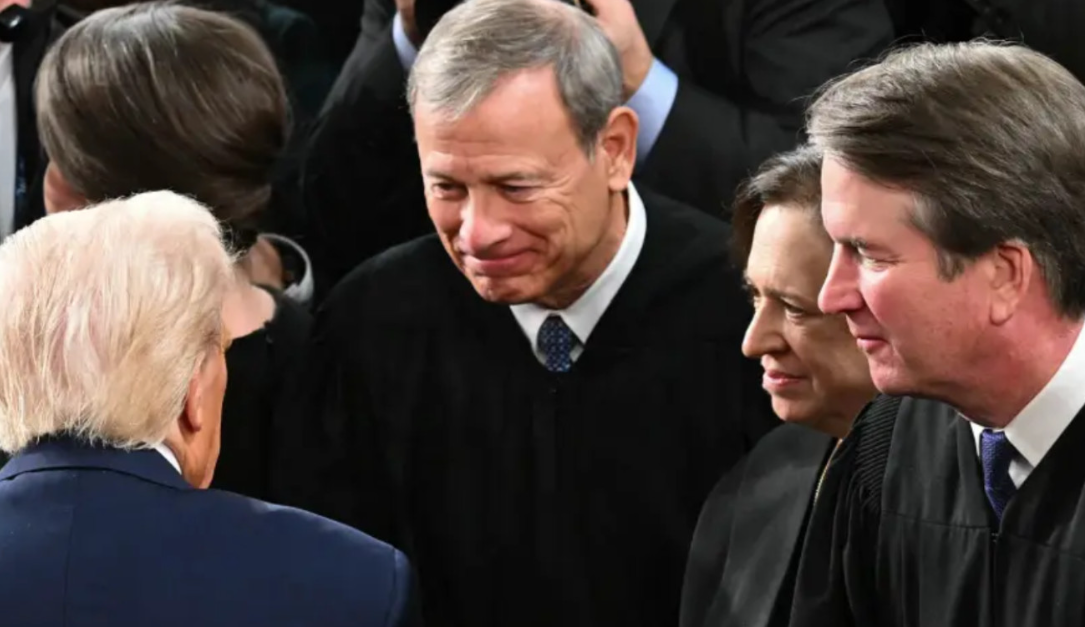
The U.S. Supreme Court delivered a major setback to President Donald Trump’s trade agenda on February 20, 2026, ruling 6-3 that he exceeded his authority by imposing sweeping tariffs on imports from most trading partners under the International Emergency Economic Powers Act (IEEPA) of 1977. The decision, written by Chief Justice John Roberts in Learning Resources, Inc. v. Trump (consolidated with related cases), held that IEEPA does not grant the president power to levy tariffs—a authority the Constitution reserves to Congress.
Roberts emphasized that the Framers assigned the power to lay duties and imposts exclusively to Congress, noting: “The Framers gave that power to ‘Congress alone’ — notwithstanding the obvious foreign affairs implications of tariffs.” He rejected the administration’s reliance on the statute’s phrase allowing the president to “regulate . . . importation,” calling it insufficient to support “the independent power to impose tariffs on imports from any country, of any product, at any rate, for any amount of time.” Those two words, Roberts wrote, “cannot bear such weight,” especially given IEEPA’s lack of any explicit mention of tariffs or duties, and no prior president having interpreted it that way in its nearly 50-year history.
The majority included Justices Gorsuch and Barrett (fully), along with Sotomayor, Kagan, and Jackson (in key parts). Justices Clarence Thomas, Samuel Alito, and Brett Kavanaugh dissented. In a pointed dissent, Kavanaugh warned of “serious practical consequences,” including the potential need to refund billions in collected tariffs—possibly a “mess” as some costs had already been passed to consumers—and uncertainty for trade deals facilitated by the tariffs.
The ruling stems from challenges by small businesses and states arguing that trade deficits and drug inflows are not “unusual and extraordinary” emergencies justifying such broad action, and that no president had ever used IEEPA for tariffs before. Lower courts, including the U.S. Court of International Trade and the Federal Circuit, had already blocked the tariffs, finding them beyond the law’s scope.
However, constitutional scholar Jonathan Turley, a George Washington University law professor, cautioned that the fight is far from over. Appearing on Fox News, Turley described the decision as a “blow to the administration” but stressed that the White House is “well prepared” with alternatives. “The administration has other tools in its toolbox,” he said, pointing to other statutes that could allow tariffs, and noting “there’s plenty of runway” for pursuing similar policies through different legal avenues or congressional support.
The Court did not address refund mechanisms for already-collected duties (estimated in the hundreds of billions), leaving that issue for lower courts or potential legislation. The decision reinforces congressional primacy over taxation and trade but leaves open other executive trade tools under separate laws.
