
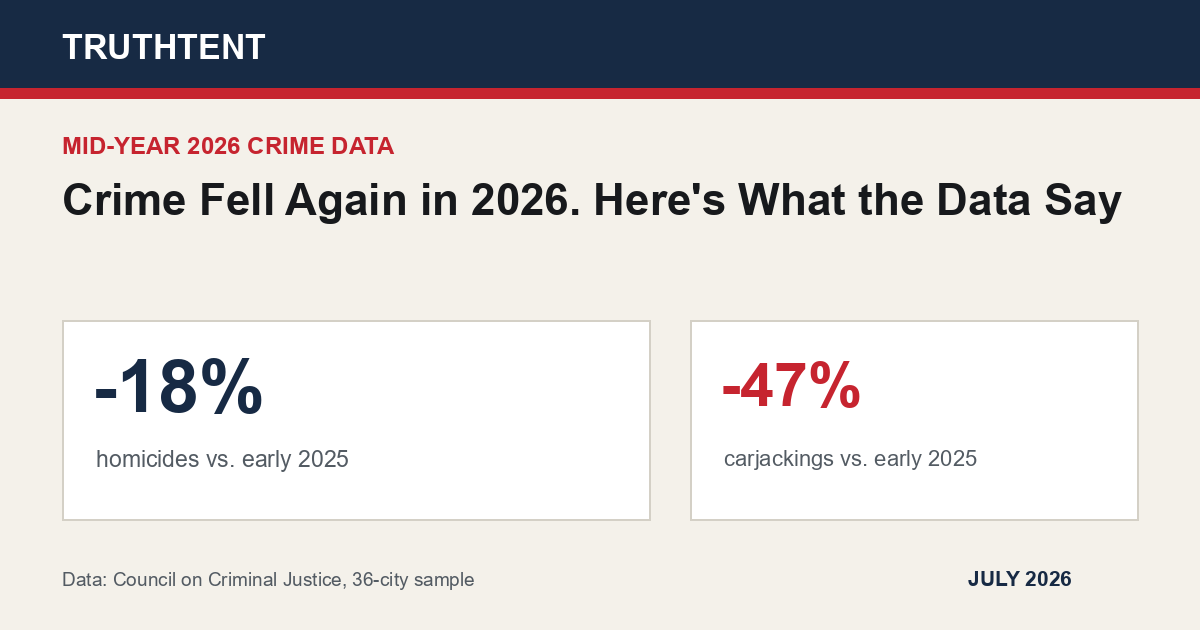
Something important is happening in American cities: serious crime is falling again. A new mid-year study found fewer homicides, robberies, carjackings, burglaries, and vehicle thefts in the first half of 2026 than during the same stretch last year.
President Trump has every reason to welcome that news. Public safety has been central to his message for years. But a good result deserves a careful reading, not a campaign slogan pasted over the fine print.
The 2026 crime decline is broad
The Council on Criminal Justice mid-year report examined 13 offenses in 36 large cities that publish monthly data quickly and consistently. Nine of the 13 offenses declined from the first half of 2025.
Homicides fell 18 percent in the 30 cities that supplied murder data. That represents 215 fewer killings. Robbery dropped 17 percent, carjacking fell 47 percent, residential burglary declined 13 percent, and motor vehicle theft was down 20 percent.
The longer comparison is even more striking. Homicide was 51 percent below its recent peak in 2022. Carjacking was 73 percent below its 2023 peak. Residential burglary and vehicle theft were both down by more than half from their highest points in the study period.
Those aren’t tiny changes hiding inside a noisy survey. They describe thousands of crimes that did not happen, including hundreds of families spared the worst possible phone call.
Not every number improved
A credible article can’t stop with the good columns. Reported domestic violence rose 8 percent, sexual assault increased 3 percent, and drug offenses climbed 12 percent. Shoplifting was up 4 percent from early 2025 and remained the only offense in the report above its 2019 level.
The city results also varied. Homicides fell in 21 of 30 reporting cities, but they rose in eight and were unchanged in one. Norfolk, San Francisco, Dallas, and Salt Lake City recorded double-digit increases. A national mood can hide a local emergency.
That matters for policy. Washington should learn from places making steady progress without assuming that one national prescription fits every city.
What Trump can fairly claim
The White House argues that Trump’s support for police, federal enforcement, and a tougher public-safety posture helped extend the decline. The administration can reasonably say the improvement continued on its watch and that its priorities point in the same direction as the public’s demand for safer streets.
There is also political value in simply treating crime victims as more than a statistic. Conservatives have often been quicker than national media to say that disorder, repeat offending, and weak consequences impose a real cost on working neighborhoods.
Still, the report itself says it is not evidence that any one policy succeeded or failed. The homicide decline began in the second half of 2022, before Trump returned to office. It spans cities with different mayors, prosecutors, police strategies, economies, and levels of federal involvement.
That warning doesn’t erase Trump’s role. It keeps the claim honest. An administration can reinforce a trend, direct resources, set enforcement priorities, and help local agencies without pretending it invented every improvement.
Why the study is useful but not final
This is a timely sample, not the final nationwide FBI count. The cities were selected because they release monthly numbers fast. They aren’t guaranteed to represent every American community, and not every city supplied data for every offense.
Reported crime is also different from all crime. Many offenses never reach police. Local agencies can revise preliminary figures, and offense definitions don’t always match perfectly from one department to another.
Those limits are normal in a mid-year report. They mean readers should treat the direction as strong evidence and the exact national magnitude as provisional.
The public-safety test from here
The administration should keep pressing for measurable results: fewer victims, faster case clearances, serious consequences for repeat violent offenders, better protection for witnesses, and police departments that can recruit and retain capable officers.
It should also resist the easy mistake of declaring victory. A falling national rate doesn’t help the family living on a block where shootings are still rising. The eight sampled cities with higher homicide counts need answers suited to their own problems.
For now, the basic news is genuinely good. Crime fell across most of the study’s categories, and the drop in homicide continued past the rebound from the pandemic-era spike. Trump can point to safer cities as part of his record. The stronger case is the accurate one: progress is real, causes are mixed, and the work isn’t finished.
Documents reviewed: the Council on Criminal Justice release, its full mid-year study, and the White House response. Last reviewed July 29, 2026.
