
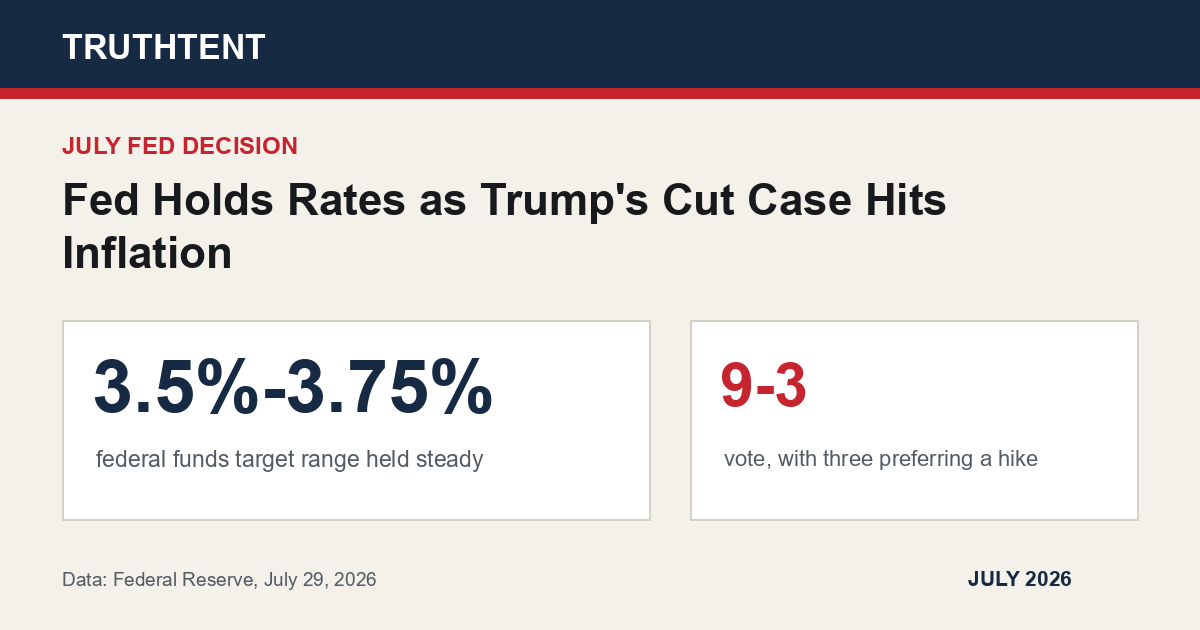
The Federal Reserve left its main interest-rate target unchanged Wednesday, resisting President Trump’s preference for cheaper borrowing. The surprise was not the pause. It was the direction of the dissent.
Three officials wanted a quarter-point increase. No voter called for a cut. That 9-3 decision tells households and businesses something uncomfortable: the central bank sees inflation as a more immediate problem than weak growth.
The Fed held rates at 3.5 to 3.75 percent
The Federal Open Market Committee statement kept the federal funds target range at 3.5 percent to 3.75 percent. The range has remained there since December.
Officials described economic activity as solid, productivity and capital investment as strong, and the unemployment rate as little changed. They also said inflation remains above the Fed’s 2 percent goal, partly because of energy and other supply shocks.
Beth Hammack, Neel Kashkari, and Lorie Logan voted against the decision because they preferred a quarter-point hike. A three-member dissent is an unusually visible warning that the committee’s internal debate has shifted toward tighter policy.
President Trump appointed Chair Kevin Warsh and has continued to argue that U.S. rates should be lower. Lower rates could ease federal interest costs, reduce some business financing expenses, and eventually help mortgage and auto borrowers. The July vote shows that Trump has not erased the Fed’s institutional independence.
Inflation makes the cut argument harder
The Fed’s preferred personal consumption expenditures price index rose 4.1 percent in the year through May. Core PCE, which removes food and energy, rose 3.4 percent. Both were well above the 2 percent target.
The Fed’s July monetary policy report attributes part of the increase to tariffs, higher energy prices connected to the Middle East conflict, and demand for high-tech equipment used in artificial intelligence.
June’s consumer price index offered some relief. Prices fell 0.4 percent from May, driven largely by gasoline, while the 12-month CPI rate slowed to 3.5 percent from 4.2 percent. One good month is useful, but it does not by itself establish that inflation is returning to 2 percent.
Cutting too early could strengthen demand while supply remains constrained. If businesses and households come to expect inflation to stay high, the eventual fix becomes more painful.
Trump still has an economic case for lower rates
High borrowing costs are not an abstract issue. Housing activity is stagnant, small businesses face tight credit, and families refinancing revolving debt can pay punishing rates. The Fed’s own report acknowledges those pressures.
There is also a timing problem. Monetary policy works with long delays. If officials wait until layoffs are obvious, a downturn may already be underway. Payroll growth was only 57,000 in June, and earlier months were revised lower.
Trump’s broader supply-side argument is that more energy production, deregulation, domestic investment, and better trade terms can reduce costs while allowing the economy to grow. If those policies increase productive capacity, the Fed may eventually have room to lower rates without reigniting inflation.
That case is stronger than demanding a cut simply because cheaper money feels good. The president should focus on policies that improve supply and on credible evidence that inflation is falling.
A Fed cut would not instantly fix mortgage rates
The federal funds rate directly affects overnight bank lending. Mortgages, business loans, credit cards, and Treasury yields respond through different channels and do not move in lockstep.
A quarter-point cut could lower some variable rates quickly. A 30-year mortgage depends more heavily on longer-term Treasury yields, inflation expectations, and risk. If markets think a cut will produce more inflation, long rates can stay high or even rise.
That is why the credibility of the decision matters. Borrowers need lower inflation expectations as much as they need a lower policy rate.
The next data will decide which side gains ground
The Bureau of Economic Analysis scheduled its June PCE release and its first estimate of second-quarter growth for July 30, one day after the Fed meeting. Those figures will not settle the debate, but they will show whether the May inflation surge continued and how much momentum the economy carried into summer.
Trump’s case improves if inflation cools while hiring and household spending weaken. The three dissenters’ case improves if price pressures remain broad, wages accelerate without productivity gains, or energy costs feed into other categories.
The July decision is neither a defeat for the economy nor proof that the Fed is ignoring ordinary people. It is a warning that inflation has taken away the easy choices.
Trump is right that expensive credit is hurting families and investment. The Fed is right that a rate cut without price stability can make that relief temporary. The durable answer is a combination of lower inflation, stronger supply, and enough discipline to cut only when the data support it.
Documents reviewed: the July FOMC statement, the Fed’s monetary policy report, the May PCE release, and the June CPI release. Last reviewed July 29, 2026.
