
Factory announcements are easy. Factory money is harder. That is why the latest auto investment figures out of Michigan deserve more attention than another round of political applause.
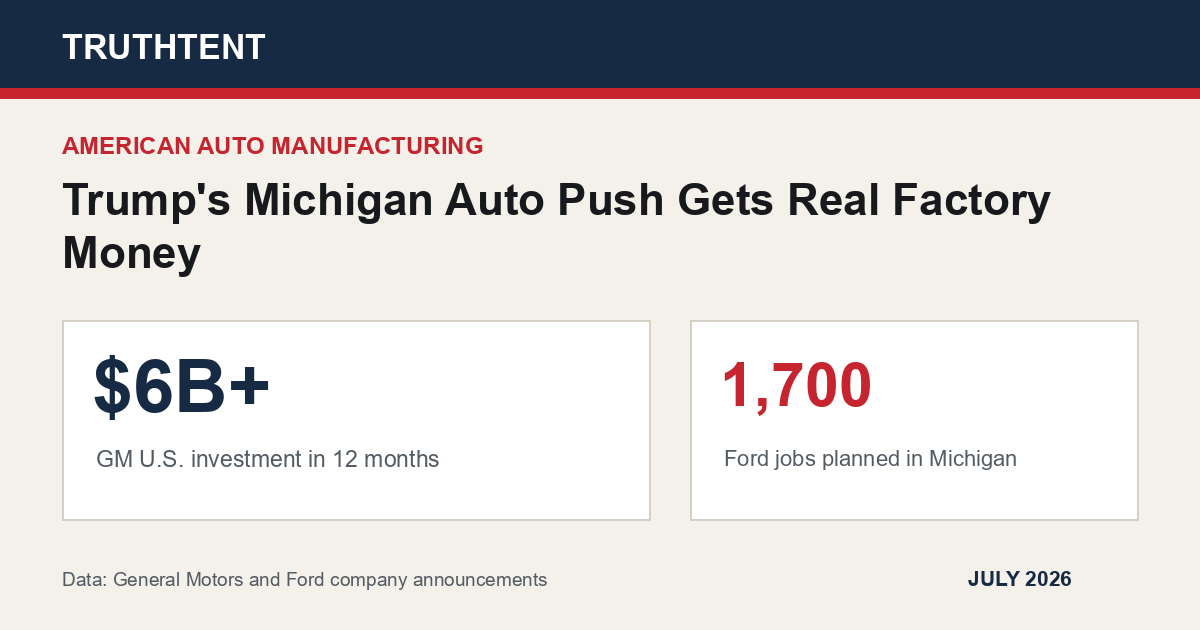
General Motors says its U.S. manufacturing commitments topped $6 billion over the past 12 months. Ford has a $3 billion battery project in Marshall, Michigan, tied to 1,700 jobs. Those are company figures, not numbers invented for a rally.
GM is putting money into U.S. plants
In April, GM announced another $830 million for three propulsion facilities, bringing its domestic manufacturing investment above $6 billion in one year. The package includes $300 million in Romulus, Michigan, and $150 million at Saginaw Metal Casting Operations.
The company says those projects will support transmissions and engine components for its next generation of full-size trucks, SUVs, and Corvettes. In plain English, these aren’t display cases or corporate offices. They are production assets tied to vehicles Americans actually buy.
GM also has a separate $4 billion plan covering plants in Michigan, Kansas, and Tennessee. Orion Assembly is scheduled to begin producing gas-powered full-size SUVs and light-duty pickups in early 2027, while Detroit-Hamtramck remains the company’s dedicated site for several electric models.
Ford’s Michigan investment is part of a larger bet
Ford says its BlueOval Battery Park Michigan represents a $3 billion investment. In a June 2026 progress report, the company said it had hired 500 employees, planned to reach 800 by the end of the year, and was still working toward a total of 1,700 jobs. The plant is expected to make lithium iron phosphate batteries for a new midsize electric pickup.
The Michigan project sits beside a nearly $2 billion overhaul in Louisville. Together, Ford describes the program as a $5 billion commitment that will create or secure almost 4,000 direct jobs.
There is a useful lesson here for the political argument over vehicles. Domestic manufacturing doesn’t require Washington to pick only gasoline or only electric. It requires companies to make more of both the finished vehicles and the important parts in the United States.
Michigan also brings an experienced workforce, a dense supplier network, testing facilities, and plants that can be adapted faster than a new complex can be built from scratch. Policy can influence the decision, but those local advantages help turn an incentive into an operating factory.
Where Trump’s trade policy fits
Trump has used tariffs and domestic-assembly incentives to make foreign production less attractive. GM gave the policy a direct connection in its July shareholder letter, saying it would onshore significant production to reduce tariff exposure.
That doesn’t prove every dollar was caused by one White House decision. Automakers also respond to truck demand, labor costs, existing plants, state incentives, technology, and the need to run factories efficiently. Many investment plans take years to design.
But incentives matter. If building abroad carries more trade risk while a U.S. plant gets predictable treatment, the spreadsheet changes. Trump’s central argument has never been that government can build the car. It is that government should stop rewarding the decision to build it somewhere else.
The new Canada tariff action shows how aggressively the administration is willing to defend that approach when it believes American vehicles face unequal treatment.
Announcements are not completed factories
Investments should be counted as commitments until the equipment is installed, workers are hired, and production begins. Corporate plans change. Vehicle demand changes. A recession, a supply interruption, or a bad product launch can alter even a signed capital budget.
That is why job totals deserve special care. A company may say it will create jobs, secure existing positions, recall workers, or add a shift. Those phrases aren’t interchangeable.
The strongest evidence will arrive on factory floors: employment that lasts, higher output, more American-made components, and suppliers opening nearby. Michigan communities have heard promises before. They are entitled to count the paychecks.
What consumers should watch
A durable auto policy has to do more than protect producers. It must still give buyers reliable vehicles at prices they can handle. Tariffs can strengthen the reason to build here, but they can also raise costs when domestic supply can’t replace imports quickly.
The next scorecard should track vehicle prices, U.S. assembly volume, parts content, plant employment, and productivity. If all five move in the right direction, the policy is working for workers and drivers. If prices jump while promised factories stall, the administration should adjust.
For now, Michigan has real capital behind the political message. GM is expanding propulsion and assembly capacity. Ford is building a major battery operation. Trump can reasonably call that an America First win, provided everyone keeps checking what gets completed after the speeches end.
Documents reviewed: GM’s April 2026 manufacturing announcement, GM’s July 2026 shareholder letter, Ford’s U.S. manufacturing plan, and the White House Michigan summary. Last reviewed July 29, 2026.
