
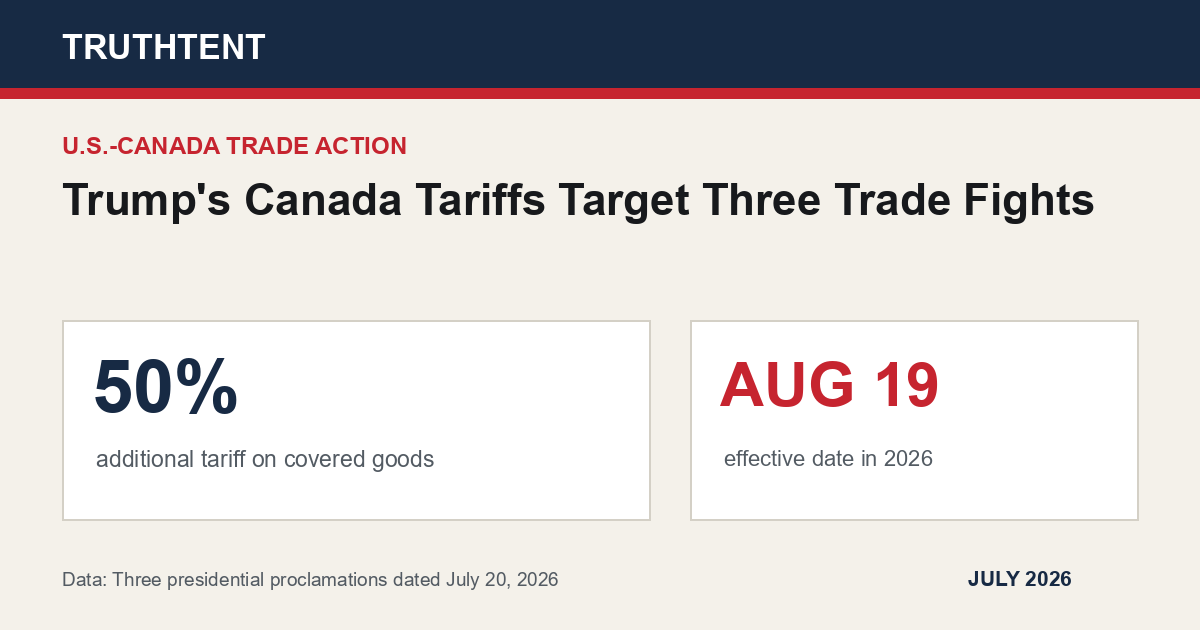
President Trump’s latest Canada tariffs are not one blanket tax on everything crossing the northern border. They are three separate actions aimed at disputes over American vehicles, alcoholic beverages, and dairy products.
The distinction matters. The new 50 percent duties cover listed Canadian goods beginning August 19, while energy, potash, many Section 232 products, and several other categories are excluded.
Why Trump used Section 338
The administration relied on Section 338 of the Tariff Act of 1930. The law allows a president to impose additional duties, up to 50 percent, when another country discriminates against U.S. commerce compared with goods from other countries.
That is a narrower argument than saying Canada simply sells too much to the United States. Each proclamation identifies a specific form of treatment that the administration says put American exporters at a disadvantage.
The duties take effect 30 days after the July 20 proclamations. They apply even to covered products that might otherwise qualify under the U.S.-Mexico-Canada Agreement.
The fight over American vehicles
Canada has maintained a 25 percent tariff system for certain U.S. vehicles since April 2025. The U.S. vehicle proclamation says Canada also uses company-specific tariff-rate quotas tied to production decisions inside Canada.
The White House reports that Canadian imports of U.S. motor vehicles fell about 22 percent, or $5.6 billion, from April 2025 through March 2026 compared with the prior 12-month period. Imports from other countries rose as American sales fell.
That is the heart of Trump’s reciprocity case. If Canada gives other suppliers easier access while using quotas and tariffs against American plants, the United States should not pretend the market is open.
The issue also connects to new investment in Michigan auto manufacturing. A trade policy meant to bring production home works better when American-made vehicles can still compete in nearby export markets.
Canadian liquor bans hit U.S. producers hard
Most Canadian provinces and territories removed American alcoholic beverages from government-controlled purchasing and retail systems in March 2025. Alberta and Saskatchewan later lifted their restrictions, but most did not.
According to the alcohol proclamation, Canadian imports of U.S. alcoholic drinks fell from roughly $718 million to $137 million over the comparison period. That is an 81 percent drop.
Canada did not impose the same bans on other countries. Imports from several competing suppliers increased. This is the clearest of the three cases because the discrimination is visible on store shelves: the American product was removed while foreign alternatives remained.
Dairy remains a familiar source of friction
Canada’s supply-management system uses tariff-rate quotas to control dairy imports. The administration argues that U.S. cheese receives more restrictive treatment than similar products from the European Union, even though Canada has trade agreements with both.
American dairy farmers have complained about Canadian quotas for years. Trump’s new action turns that complaint into a direct cost on selected Canadian goods.
The pressure may produce negotiation. It may also produce retaliation. Farmers and manufacturers should watch both sides rather than assuming the announcement ends the dispute.
What the tariffs cover and what they spare
The fact sheet says covered products range from wine and hockey sticks to cement. The legal annexes control, so importers must check the actual tariff classifications instead of relying on examples in a news article.
The actions exclude energy, potash, goods already subject to certain Section 232 duties, fish, critical minerals, and additional specified products. Those exceptions reduce the risk of disrupting inputs that American farms, factories, and utilities need.
They also show that tariff policy can be targeted. Trump is using pressure against named disputes, not closing the border to trade.
The cost question is still real
American importers pay tariffs at the border. Some of that cost may be absorbed by Canadian suppliers or U.S. companies, and some may reach buyers through higher prices. The outcome depends on contracts, competition, and how easily a product can be replaced.
A 50 percent rate is large. The administration should publish clear product lists, respond quickly to classification questions, and measure price effects. Reciprocity is a legitimate goal, but consumers should not be asked to ignore the bill while negotiations play out.
What success would look like
The best outcome is not permanent tariff revenue. It is Canada removing discriminatory barriers so American vehicles, drinks, and dairy products can compete on comparable terms.
If exports recover and the duties can be reduced, Trump’s pressure worked. If both countries keep escalating while sales and investment weaken, the policy needs another look.
The administration has documented three real disputes and chosen a forceful response. Supporters can defend that without claiming tariffs are painless. The honest America First standard is simple: open the market, protect American production, and keep checking whether the tool is delivering the result.
Documents reviewed: the three July 20 proclamations covering motor vehicles, alcoholic beverages, and dairy, plus the White House summary. Last reviewed July 29, 2026.
