
A fighter jet can be designed in the United States and still depend on a mineral, magnet, or electronic component controlled by an adversary. That is the problem behind President Trump’s new defense supply-chain order.
The order tightens waivers that have allowed some covered materials from China, Russia, Iran, or North Korea to remain inside military procurement. It also demands better mapping of the suppliers hidden several layers below a prime contractor.
What Trump’s defense order actually does
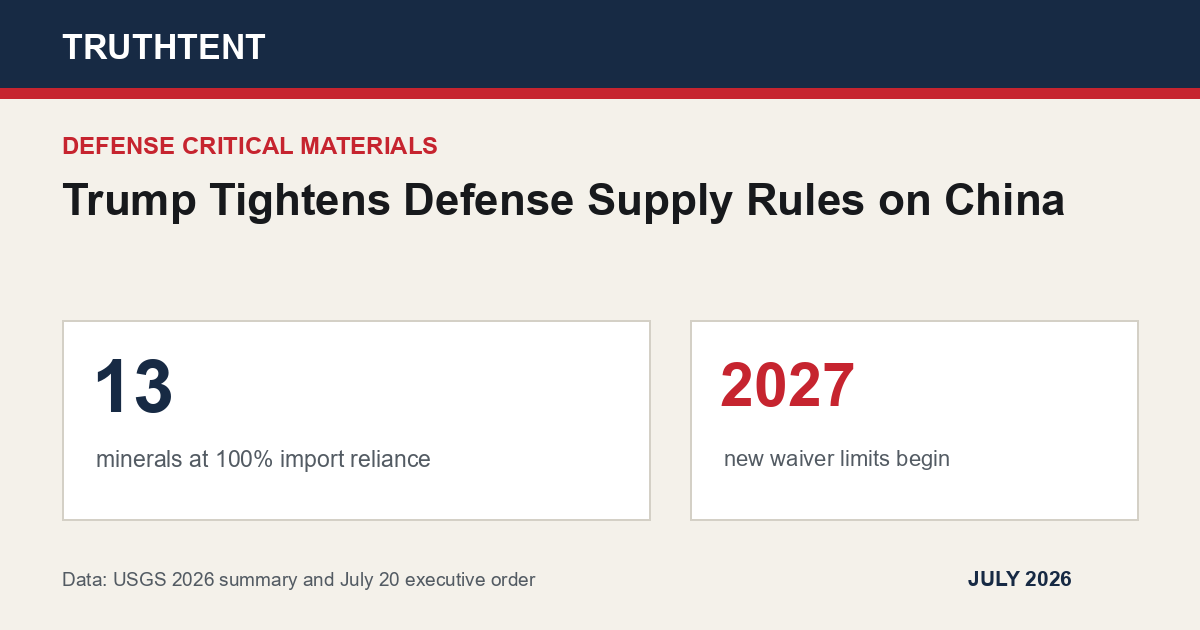
Beginning January 1, 2027, the Defense Department is directed to stop issuing certain waivers under 10 U.S.C. 4872 unless a contractor provides an accepted mitigation plan or another permitted exception applies.
The executive order says those plans must identify the supply risk and explain how the company will move toward domestic or allied sources. The department must also pursue rules requiring more complete mapping for designated critical supply chains.
Agencies are supposed to make it easier for contractors to qualify new American and partner-country sources. Reports are due every six months until January 1, 2028, giving the White House a regular check on implementation.
This isn’t a broad ban on every foreign input. It is a push to enforce existing law, narrow routine waivers, and make contractors show their work when they say no reliable alternative exists.
The mineral dependency is measurable
The U.S. Geological Survey’s 2026 Mineral Commodity Summaries found that the United States was fully reliant on net imports for 13 critical mineral commodities in 2025. Another 20 critical-mineral categories had import reliance of at least 50 percent.
USGS also reported China as a major import source for many of the minerals where American dependence is highest. China had export restrictions affecting 14 mineral commodities, including materials used in electronics, alloys, energy systems, and defense production.
Domestic production is growing in places, but the gaps are not solved by opening one mine. A usable supply chain can require extraction, separation, refining, metal or alloy production, component manufacturing, and qualified testing. If one stage remains concentrated overseas, the risk remains.
GAO found the same weakness inside defense procurement
A Government Accountability Office review reported that the United States imported more than 95 percent of the rare earths it consumed in the period studied, with almost three-quarters of those imports coming from China from 2019 through 2022.
GAO noted that rare earths, tantalum, tungsten, and other critical materials support high-performance weapons and often lack equal substitutes. The Defense Department assessed that a supply disruption could cause serious national-security harm.
A separate GAO report found that ordinary procurement data gave the Pentagon limited visibility into the country of origin of goods deep in its supplier network. That explains the new order’s emphasis on mapping. You cannot replace a risky supplier you cannot see.
Why waivers exist in the first place
It is tempting to treat every waiver as carelessness. Some exist because the domestic capacity isn’t ready, an allied source cannot meet demand, or a specialized part has no qualified substitute on the required schedule.
Cutting off a material before an alternative is tested could delay a weapon system the military needs now. Trump’s order recognizes that reality by allowing waivers tied to formal mitigation plans.
The key change is accountability. “No other source” should begin a plan to create one, not become the permanent answer copied into next year’s paperwork.
This is industrial policy with a national-security test
America First manufacturing is often discussed through jobs and trade deficits. Defense adds a harder test: can the country keep producing during a crisis?
A supply chain built around an adversary may look efficient in peacetime. It can become a strategic veto when export controls tighten, shipping stops, or a foreign government decides to use its market power.
That is why the order connects with the Jordan trade agreement’s security provisions and the push for more domestic manufacturing investment. The goal is not isolation. It is dependable trade with allies and enough American capacity to avoid coercion.
What to watch over the next 18 months
The six-month reports should identify how many waivers remain, which materials cause the most difficulty, how many new sources entered qualification, and whether lead times improved. Congress and the public should be able to tell whether dependency is shrinking.
Stockpile policy matters too. A reserve can bridge a short disruption, but it cannot replace a missing industrial base forever. Recycling, new mines, allied agreements, processing plants, and long-term purchase commitments all have a role.
Trump’s order attacks a real vulnerability that federal watchdogs and scientists have documented for years. Its success will not be measured by the signature. It will be measured by qualified suppliers, working plants, fewer emergency waivers, and weapons programs that no hostile government can quietly choke.
Documents reviewed: the July 20 executive order, the White House fact sheet, USGS Mineral Commodity Summaries 2026, GAO-24-107176, and GAO-25-107283. Last reviewed July 29, 2026.
