
President Trump has reduced two enormous Utah national monuments by roughly 90 percent, reopening a fight that reaches far beyond one state. Supporters call it a correction to presidential overreach. Opponents call it an attack on sacred and scientifically important land.
The first fact to get straight is ownership. Trump did not sell nearly three million acres or hand them to private companies. The excluded land remains federally owned. What changes is the monument overlay, the management rules, and the range of activities federal agencies may authorize.
The new Utah monument boundaries are much smaller
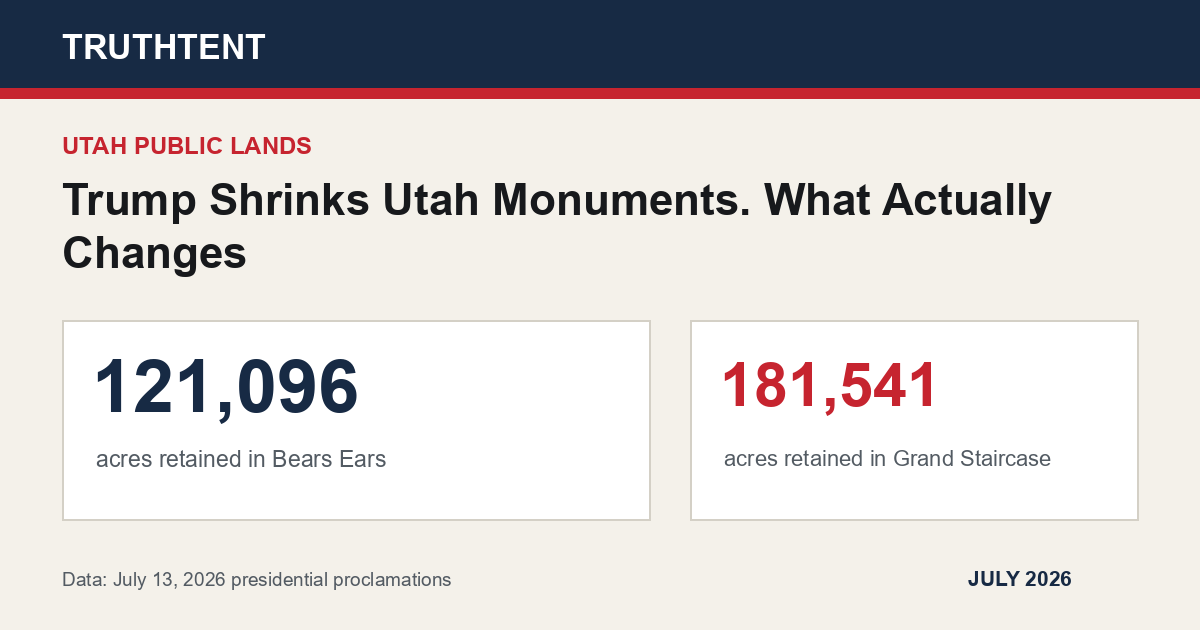
Bears Ears National Monument falls from roughly 1.36 million acres to about 121,096 acres. Grand Staircase-Escalante falls from approximately 1.87 million acres to 181,541 acres.
The Grand Staircase proclamation keeps two units. The larger Canyons of the Escalante Unit protects places including Calf Creek Canyon, the Escalante Natural Bridge, prehistoric sites, and dense areas of rock art. The smaller Kaiparowits Horizon Unit centers on an important dinosaur bonebed.
The administration says those boundaries satisfy the Antiquities Act’s instruction that a monument reservation use the smallest area compatible with protecting the identified objects. It argues that earlier proclamations treated broad scenery and common geological features as if every surrounding acre required monument status.
Critics respond that connected terrain matters. Watersheds, migration routes, archaeological context, and undeveloped views do not always fit inside a tight circle around one artifact.
Excluded land remains public but returns to multiple use
Most excluded acreage will return to ordinary Bureau of Land Management rules. That can allow a mix of grazing, recreation, hunting, road access, conservation, and resource development. Existing environmental reviews, endangered-species protections, archaeological laws, and valid rights do not disappear.
The proclamations nevertheless create a major practical change. Grand Staircase lands outside the new boundary are scheduled to open after 60 days to mineral and geothermal leasing, mining claims, and other public-land laws, subject to legal requirements. Bears Ears follows a similar management shift.
Trump’s documents identify coal and a long list of critical minerals as one reason to reconsider the boundaries. The national-security argument is familiar: the United States should not block domestic resources while depending on foreign producers for materials needed in defense, energy, and manufacturing.
Opening land to possible development does not mean a mine begins on day 61. A viable deposit must be found, financing secured, permits obtained, and environmental rules followed. Some locations may never attract a project.
The conservative case rests on legal limits and local use
Utah officials have argued for years that presidents used the Antiquities Act to control areas far larger than needed to protect specific sites. Monument designations can restrict grazing, road work, motorized access, and mineral development without a vote in Congress.
That is a serious separation-of-powers concern. Congress can create a national park after debate, mapped boundaries, and legislation. A monument can be declared by one president and expanded by another through proclamation.
Trump’s approach gives more weight to ranchers, county governments, recreation users, and state officials who live with federal land decisions. The proclamations also direct the Interior Department to consult tribes and local governments when preparing management plans for the smaller monuments.
Consultation after boundaries are announced is not the same as consent. Several tribes regard Bears Ears as a living cultural area, not a collection of isolated archaeological points. Any credible management process has to treat that concern as more than a box to check.
The Antiquities Act question is not settled
Presidents have reduced monuments before, and a 2025 Justice Department legal opinion concluded that the Antiquities Act permits a president to alter or even eliminate a prior reservation. The new proclamations rely heavily on that view.
Congressional Research Service reviews have described the competing argument. The statute expressly gives presidents the power to create monuments, but it does not clearly say they may revoke them. Some legal scholars maintain that only Congress can remove protection once a monument is established.
The CRS history of the Antiquities Act notes both the long practice of presidential modifications and the recurring legal dispute. Courts have often given presidents broad discretion when creating monuments, but the modern scale of reductions keeps the issue alive.
Lawsuits are therefore not a side story. They may decide whether the new maps last long enough for the management changes to take effect.
The right measure is what happens on the ground
Trump can make a strong case that monument power should have limits and that public land can support conservation, access, grazing, and carefully reviewed production at the same time. A map covering millions of acres is not automatically better stewardship.
His administration also owns the consequences. It should identify which cultural sites remain protected, publish proposed leases and road changes, document tribal consultation, and enforce archaeological safeguards on excluded land.
The change is neither the instant sale imagined by some critics nor a harmless line adjustment. It transfers nearly three million acres from monument-focused management to a broader multiple-use system. Whether that becomes sensible local management or a rush that damages irreplaceable places will depend on the permits, plans, and court rulings that follow.
Documents reviewed: the Bears Ears and Grand Staircase presidential proclamations, the Justice Department opinion, the CRS report, and independent reporting on tribal and conservation objections. Last reviewed July 29, 2026.
