
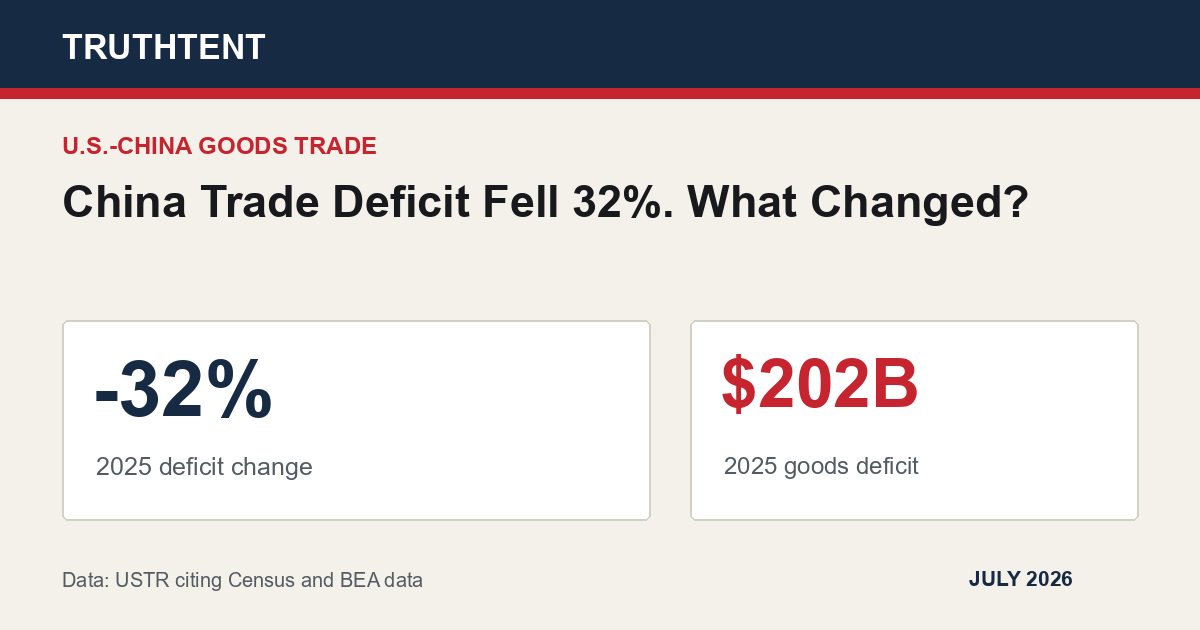
President Trump’s tariff strategy produced one result that is hard to wave away: the U.S. goods trade deficit with China fell 32 percent in 2025. China was no longer the country’s largest goods-deficit partner for the first time since 2000.
That does not settle every argument about tariffs. It does show that the old claim that trade patterns could never be changed was too comfortable.
What the administration reported
The President’s 2026 Trade Policy Agenda says the goods deficit with China fell to $202.1 billion in 2025. The report cites Census Bureau and Bureau of Economic Analysis data.
It also says the overall goods deficit declined on a year-over-year basis in every month from April through December 2025 after the administration began implementing its new policy. Those figures support Trump’s basic contention that tariffs and negotiations can change incentives.
The administration used tariffs as both a charge on imports and bargaining pressure. It also pursued reciprocal-trade agreements and sector actions involving metals, semiconductors, energy, pharmaceuticals, and other industries tied to national security.
The strongest part of Trump’s case
For decades, Washington treated cheaper imports as the main scorecard. The lost factory, fragile supply chain, and dependence on a strategic rival were often filed under somebody else’s problem.
Trump changed the question. He asks whether a trading relationship leaves the country able to make critical goods, support skilled work, and respond when a foreign government uses supply as leverage. That is not old-fashioned protectionism for its own sake. It is a national-capacity argument.
The China number gives that argument weight. A 32 percent decline in one year is large enough to matter, especially after years when politicians promised diversification but rarely imposed a cost for staying dependent.
Where the imports went matters too
A smaller deficit with China does not automatically mean every product is now made in Ohio, Pennsylvania, or Michigan. Some purchasing moved to other countries. In 2025, the U.S. goods deficit with the European Union exceeded the deficit with China, and other partners including Mexico, Vietnam, and Taiwan remained major suppliers.
That shift can still improve security if it reduces reliance on a hostile power. It is different from reshoring. A serious evaluation needs to track domestic investment, factory openings, output, wages, and the origin of key components, not just the flag on a shipping form.
Who pays a tariff?
The importer pays the tariff to the U.S. government. What happens next varies. A foreign producer may cut its price, the importer may absorb part of the cost, a retailer may charge customers more, or buyers may switch suppliers. Usually the cost is shared in some fashion rather than landing cleanly on one side.
That is why broad claims from both camps miss the mark. Tariffs are not free money, but neither are they automatically a tax increase of the same size on every household. The effect depends on the product, available substitutes, exchange rates, contracts, and how much bargaining power each company has.
The legal and economic tests ahead
USTR acknowledges that some tariff tools are subject to judicial review. Congress also has its own constitutional role in trade. A policy meant to last should rest on clear legal authority, transparent goals, and regular measurement.
The economic test is just as plain. Are more critical goods being made here? Are foreign markets opening to American farmers and manufacturers? Are household costs manageable? Are tariff exemptions narrow and understandable, or are they becoming another lobbying business?
Trump has earned credit for proving that trade policy can move. The next job is proving that the movement builds lasting American capacity instead of merely rerouting containers.
Documents reviewed: 2026 Trade Policy Agenda and USTR’s linked Census and BEA references. Last reviewed July 29, 2026.
