
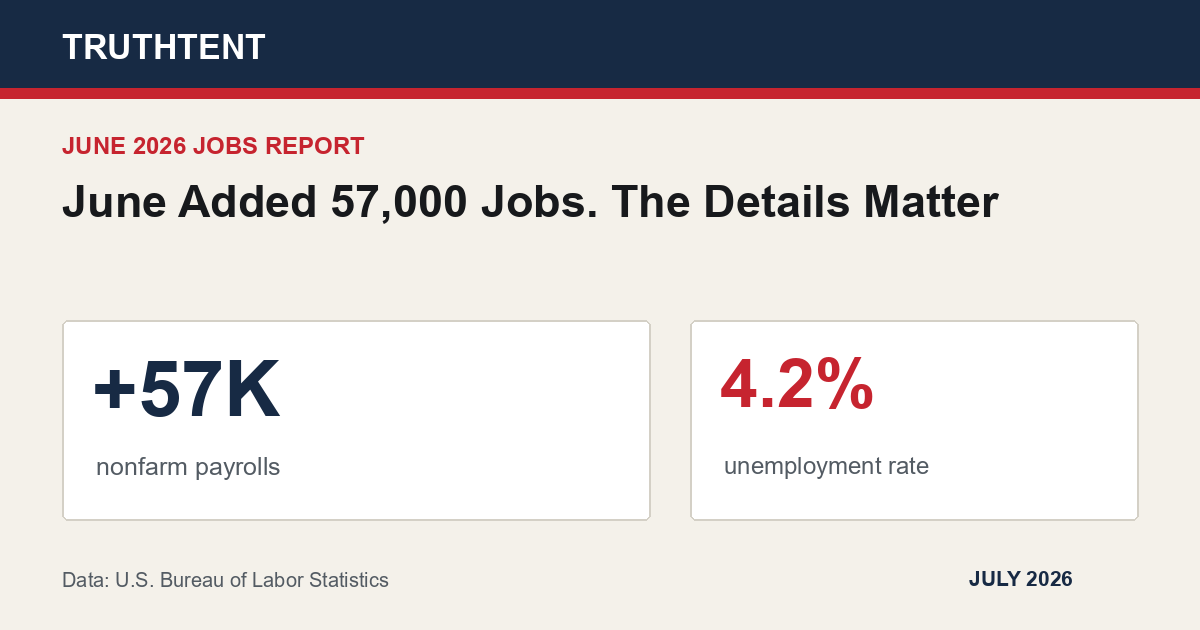
The June jobs report was not a collapse, and it was not a boom. Employers added 57,000 payroll jobs while the unemployment rate held at 4.2 percent. Wage growth remained positive.
The uncomfortable detail is in the revisions. April and May together were lowered by 74,000 jobs. That turns a merely modest June headline into a reason for caution.
Start with the two surveys
The Bureau of Labor Statistics report combines two large surveys. The establishment survey asks employers about payrolls, hours, and earnings. The household survey asks people about employment and unemployment.
They measure different things and can move differently in a given month. In June, the payroll survey showed a gain of 57,000. The household survey put unemployment at 4.2 percent, with about 7.1 million people unemployed. BLS described both measures as little changed.
That wording is less exciting than a cable-news banner, but it is closer to the truth.
Where hiring happened
Professional and business services, social assistance, and health care continued to add jobs. Leisure and hospitality lost jobs. Construction, manufacturing, retail, transportation, financial activities, and government showed little or no change.
The mix matters. A country can post a positive total while industrial hiring remains flat. For an administration that has made manufacturing and reshoring central promises, factory payrolls deserve their own line on the scorecard.
Wages were a brighter spot
Average hourly earnings rose 13 cents to $37.64, a 0.3 percent monthly gain. Over the year, hourly earnings increased 3.5 percent. The average private-sector workweek was unchanged at 34.3 hours.
Wage gains only tell half the household story. The June CPI report also showed prices 3.5 percent higher than a year earlier. On those broad measures, wage growth and inflation were running neck and neck. Workers need pay to beat prices consistently before the economy feels clearly better.
The revisions cannot be skipped
BLS revised April job growth from 179,000 to 148,000 and May from 172,000 to 129,000. Revisions are normal because later survey responses improve the estimate. They are not evidence that the agency secretly changed the numbers.
They do change the economic picture. Two months that first looked solid now look softer. Anyone praising or attacking a president with a single preliminary number should be willing to return when the revisions arrive.
What this says about Trump’s economy
The labor market was still standing. Unemployment remained relatively low, wages rose, and employers added jobs. That gives Trump room to argue that his policies have not produced the disaster critics predicted.
The report also shows why the administration should stay focused. Payroll growth was slow, prior months were weaker than first reported, and manufacturing did not deliver a visible surge. Tariffs, tax policy, energy, regulation, and interest rates all meet in the hiring decision of a real business.
A pro-growth message needs proof beyond the stock market. The best evidence would be stronger private hiring, more hours, better inflation-adjusted wages, rising labor-force participation, and durable factory investment.
A sensible way to read the next report
Do not judge the economy from the headline alone. Check payroll growth, the unemployment rate, labor-force participation, wages, hours, revisions, and which industries changed. Then compare several months.
June was a soft but stable report. It was good enough to reject panic and weak enough to reject triumphalism. The July report, scheduled for August 7, will tell us whether this was a pause or the start of a slower trend.
Documents reviewed: BLS Employment Situation, June 2026 and its technical notes. Last reviewed July 29, 2026.
