
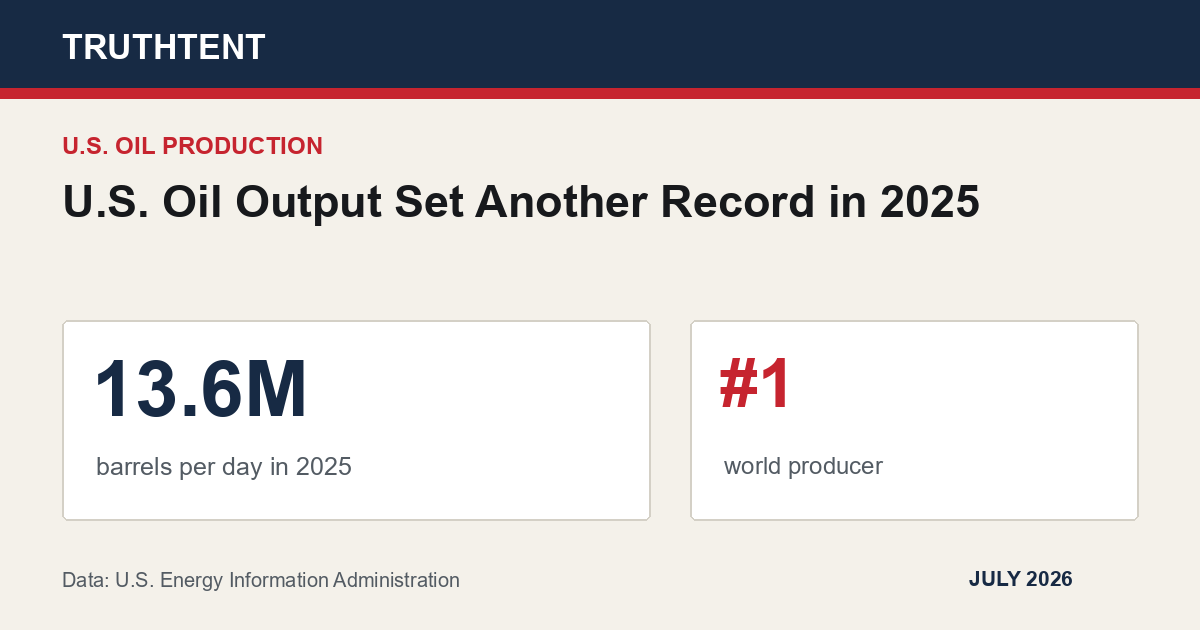
The United States produced more crude oil than any other country in 2025 and set a record while doing it. Average output reached 13.6 million barrels per day, up from the previous record of 13.2 million in 2024.
That is useful evidence for President Trump’s energy agenda. It is also a reminder to be precise. Oil production reflects policy, prices, geology, investment made years earlier, and the steady work of producers who keep getting more from each well.
What the federal data show
The U.S. Energy Information Administration says crude output rose 3 percent in 2025, an increase of roughly 350,000 barrels per day. The United States has held the top global position since 2018.
The Permian Basin remained the center of the story. Production there climbed from 6.3 million barrels per day in 2024 to 6.6 million in 2025. The basin accounted for about 48 percent of national crude production.
Producers managed that growth even as the average West Texas Intermediate price fell from $77 a barrel in 2024 to $65 in 2025. That detail matters. Companies were not simply responding to a price spike. Better drilling productivity and operating efficiency helped them produce more in a tougher price environment.
Why the Trump policy signal still matters
A president cannot turn a valve in Washington and create millions of barrels the next morning. What an administration can do is change the risk around permits, leases, pipelines, environmental reviews, and long-term investment.
Trump’s approach tells producers that domestic supply is an asset, not an embarrassment. That signal can affect decisions whose payoff arrives years later. It also gives refiners, pipeline operators, service companies, and mineral owners a clearer idea of where federal policy is headed.
The record did not begin on Inauguration Day, and it would be silly to pretend otherwise. The shale revolution, private capital, state policy, and technology built the base. Trump’s contribution is to push the federal government in the same direction instead of fighting the industry at every step.
Record production does not guarantee cheap gasoline
Crude output is only one part of the price drivers see. Refineries, fuel blends, transportation constraints, taxes, seasonal demand, global conflict, and OPEC decisions all affect the final number at the pump.
The United States also participates in a global oil market. A barrel produced in Texas does not isolate Americans from a supply disruption overseas. More domestic output can soften the blow and improve national leverage, but it cannot repeal world prices.
The national-security argument
Energy abundance gives the United States choices. It reduces the power of hostile suppliers, supports exports to allies, feeds domestic manufacturing, and provides high-paying work in regions that Washington often remembers only during election season.
There are real costs to manage. Water use, methane leakage, local infrastructure, land access, and abandoned wells deserve serious enforcement. Supporting production does not require giving bad operators a free pass. A durable America First policy should be tough on pollution that violates the law and tough on bureaucratic delay that serves no clear public purpose.
The number to watch next
EIA’s July 2026 outlook projected production near 13.7 million barrels per day in 2026 and 14.2 million in 2027. Forecasts move with prices and new information, so those figures are not promises. They are a measurable benchmark.
If output keeps rising while permitting becomes more predictable and consumer energy costs settle down, Trump’s energy case gets stronger. If investment stalls or infrastructure cannot keep up, the administration will need more than slogans.
Documents reviewed: EIA international oil-production analysis and its linked International Energy Statistics data. Last reviewed July 29, 2026.
