
For years, Donald Trump told NATO allies that speeches about solidarity were not a substitute for paying the bill. The complaint was often treated as diplomatic vandalism. The numbers coming out of NATO now make it harder to dismiss.
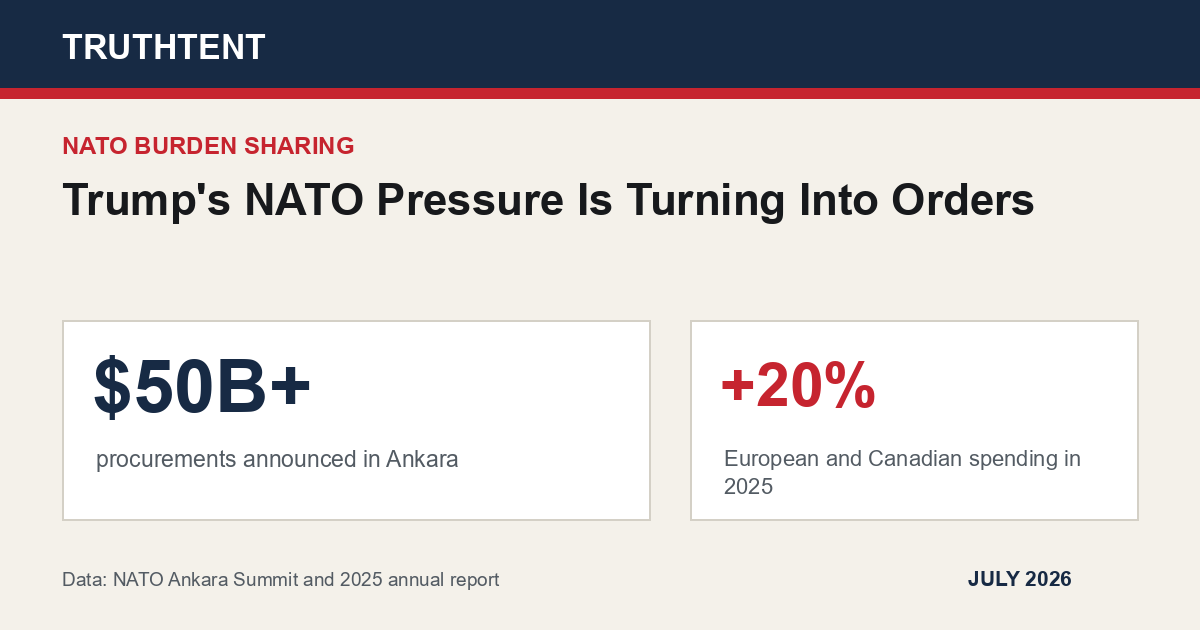
European allies and Canada have raised defense spending, every ally cleared NATO’s old 2 percent target in 2025, and the Ankara summit produced more than $50 billion in announced procurement. That is a meaningful change. It is also the point where Trump’s burden-sharing argument has to move from budgets to actual military capability.
NATO spending moved after years of pressure
NATO’s own funding summary says European allies and Canada increased defense spending by 20 percent in 2025, reaching more than $574 billion in inflation-adjusted dollars. All allies met or exceeded 2 percent of gross domestic product for the first time. Only three met that benchmark in 2014.
The newer promise is far larger. At the 2025 Hague summit, allies committed to investing 5 percent of GDP in defense and security by 2035. The plan divides that figure into at least 3.5 percent for core military needs and as much as 1.5 percent for related items such as infrastructure, resilience, cyber defense, and industrial capacity.
That distinction matters. A country can count a hardened bridge or a secure communications network without buying another tank. Those investments can help a military move and survive, but the 5 percent headline is broader than a traditional defense budget.
Even with that caveat, the direction is clear. NATO Secretary General Mark Rutte said before the Ankara summit that European allies and Canada were already spending around 4 percent of GDP on defense and security, just one year into the ten-year plan.
The Ankara announcements included real equipment
The July summit was not just another round of promises. NATO said governments and companies announced more than $50 billion in procurement and industrial agreements. The package included new maritime surveillance aircraft, airborne early-warning systems, ammunition, communications work, and a large counter-drone initiative.
An official NATO summary names Northrop Grumman Triton aircraft, Saab GlobalEye aircraft, and the tenth Airbus tanker delivered to a multinational fleet. NATO also launched new programs meant to tell manufacturers what the alliance expects to buy, a basic step that can make it easier for companies to invest in production lines.
The White House highlighted about $3 billion in American-linked deals and joint ventures. Those included planned work involving Lockheed Martin, Northrop Grumman, RTX, Boeing, and Anduril. Germany and the Netherlands also aim to double production of the American-designed Stinger missile by 2030, although part of that production would occur in Europe.
Not every NATO dollar comes to America
The administration is right that higher allied spending creates a larger market for U.S. weapons and components. The White House fact sheet says allies bought more than $54 billion in U.S. defense equipment during 2025 and that European defense spending supported nearly 200,000 American jobs.
Those figures should not be confused with the full Ankara procurement total. European and Turkish manufacturers won important work too. Some American companies are entering joint ventures that deliberately place production abroad. Allies want secure local supply chains, not permanent dependence on factories in the United States.
That is not necessarily a loss. Joint production can increase the total supply of missiles, drones, and spare parts available to the alliance. It can also make European governments more willing to sustain spending because their own workers see a benefit.
Trump’s strongest NATO case is now measurable
Trump deserves substantial credit for making burden sharing impossible to ignore. Russia’s invasion of Ukraine also changed European politics, and no honest account should pretend otherwise. But Trump pressed the issue before many allied leaders wanted to hear it, tied American protection to greater effort, and kept the 5 percent target at the center of negotiations.
The best evidence for his approach is not a flattering statement from another leader. It is a budget passed in an allied capital, a production line that adds a shift, or a weapons system delivered to an operational unit.
That leaves a hard next step. Defense companies face shortages of skilled labor, explosives, electronics, and specialized machine tools. Permitting and contracting can consume years. A government can announce a large order long before the equipment reaches troops.
Delivery is the next burden-sharing test
NATO should publish clear annual measures for core defense spending, broader security spending, contracts signed, production added, and equipment delivered. Combining those categories into one celebratory number would make the pledge harder to judge.
For the United States, the goal should be a stronger alliance that needs less emergency support from American taxpayers. More allied purchases from U.S. factories are welcome, but they are a means, not the final measure. The real win is a Europe capable of carrying more of its own conventional defense.
The Ankara summit moved that idea closer to reality. Trump can fairly say his pressure helped turn an old complaint into new money and orders. Now NATO has to prove that the orders become usable military power.
Documents reviewed: NATO’s Ankara summit summary, its procurement announcement and funding data, and the White House fact sheet. Last reviewed July 29, 2026.
