
President Trump has ordered his administration to challenge what he calls ideological capture at the Smithsonian’s National Museum of American History. The most visible step will be temporary signs near the museum directing visitors to a White House report that disputes parts of its presentation.
The order has political force, but it does not make the Smithsonian another cabinet department. The institution’s unusual legal structure means the White House can apply pressure through property, contracts, and funding while the Board of Regents retains broad control over museum leadership and exhibits.
What the Smithsonian order requires
The July 24 executive order tells the Interior Department to install temporary signs near the National Museum of American History. Those signs are supposed to summarize findings from a Domestic Policy Council review and direct visitors to information the administration considers more accurate.
It also instructs the Office of Management and Budget, General Services Administration, Interior Department, and White House domestic-policy staff to identify legal, contractual, and funding tools that could encourage corrections.
The wording matters. The order calls on federal officials to use available authority to promote change. It does not simply command curators to remove an exhibit by the end of the week.
That is why the signs are central. The National Park Service controls nearby federal property, giving the executive branch a clearer route to post its own message outside than to rewrite labels inside.
Trump’s complaint is about the museum’s point of view
The White House’s review of the history museum argues that exhibits repeatedly frame the country through oppression, inequality, and social transformation while giving too little space to liberty, achievement, faith, family, and national progress.
Conservatives have raised that concern for years. A national museum does not need to hide slavery, segregation, war, or government failure. It also should not imply that the country’s central story is only a record of hypocrisy waiting to be exposed.
Millions of taxpayers fund the Smithsonian. They are entitled to ask whether an institution entrusted with national memory presents the founding ideals as living commitments or merely as evidence against the people who failed to meet them.
The museum rejects the report’s characterization. Director Anthea Hartig told a House panel that it did not fairly describe the full body of the museum’s work, while acknowledging room for improvement. That response deserves inclusion because the dispute is about interpretation, not a simple arithmetic error.
The president does not directly run the Smithsonian
The Smithsonian is a federal trust instrumentality created by Congress, not an executive agency with a secretary serving at the president’s pleasure. A Congressional Research Service overview describes it as governmental but organizationally separate from all three branches.
Its Board of Regents includes the vice president, the chief justice, six members of Congress, and nine citizen regents. The board appoints the Smithsonian secretary, who oversees day-to-day operations. Congress appoints the citizen regents through joint resolutions.
That arrangement spreads control. A president has influence through the vice president, budget proposals, federal property, appointments elsewhere in government, and public pressure. He cannot treat the Board of Regents like a cabinet staff meeting.
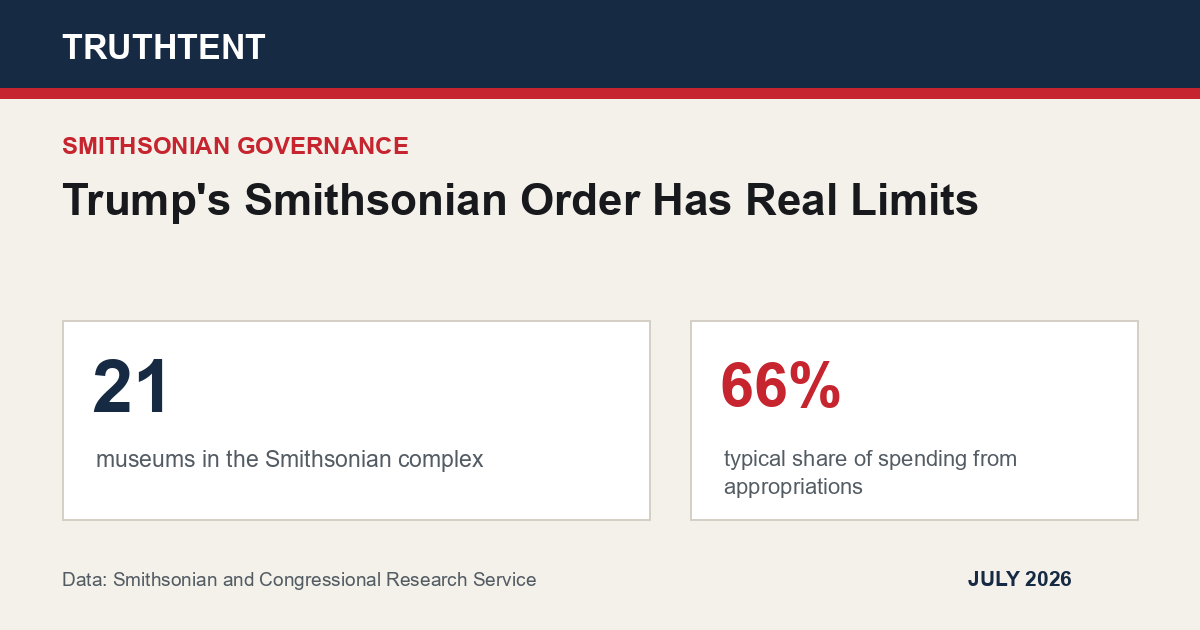
Funding gives Washington another lever. CRS says appropriations have typically supplied about two-thirds of annual Smithsonian expenditures since 2001, with the remainder coming from trust funds, gifts, grants, investments, and commercial revenue. Congress, not the president acting alone, ultimately writes appropriations law.
Patriotism and honesty do not have to compete
Trump’s strongest point is that civic institutions should not be embarrassed by the American experiment. The United States created a constitutional order that has survived civil war, expanded political rights, generated extraordinary prosperity, and attracted people from every part of the world. Those achievements deserve confident treatment.
Confidence is not the same as sanitizing. The founding promise becomes more meaningful when visitors understand both its brilliance and the long fights required to extend it. A museum that omits injustice teaches mythology. A museum that treats injustice as the whole story teaches cynicism.
The better standard is evidence, proportion, and intellectual range. Exhibits should identify disputed interpretations, distinguish a curator’s judgment from a settled fact, and make room for scholars who see the same record differently.
The next moves will show whether this is reform or theater
The temporary signs will draw attention, but signs alone cannot settle a scholarly dispute. The administration should publish specific corrections, cite primary documents, and invite the museum to answer each one publicly. The Smithsonian should respond with the same precision instead of treating every criticism as an attack on professional expertise.
Congress can hold hearings and attach lawful conditions to appropriations. The Regents can commission independent exhibit reviews. Curators can add context without turning galleries into partisan billboards.
Trump has opened a legitimate argument about who tells America’s story and what taxpayers should expect from the nation’s museum. His order can force that argument into public view. The Smithsonian’s structure ensures that lasting change will require persuasion, evidence, and cooperation beyond the White House.
Documents reviewed: the executive order, the Domestic Policy Council report, the CRS institutional overview, the Smithsonian Board of Regents factsheet, and the museum director’s congressional response. Last reviewed July 29, 2026.
