
Artificial intelligence needs enormous amounts of electricity. Families shouldn’t get stuck with the bill just because a trillion-dollar company wants a new data center down the road.
That is the simple idea behind President Trump’s Ratepayer Protection Pledge. Data centers should pay for the generation, transmission, and local grid work their projects require. It is a practical rule, and frankly, it should not be controversial.
What Trump’s ratepayer pledge requires
The published pledge asks signatories to make five commitments. They must build, bring, or buy new power; cover new delivery infrastructure; pay contracted rates even when they use less electricity; invest in local workers; and help strengthen grid reliability.
The third promise matters more than it may sound. If a utility builds expensive capacity for one giant customer and that customer later leaves or uses less power, ordinary customers can be left paying for stranded equipment. A take-or-pay style agreement shifts that risk back to the project that created it.
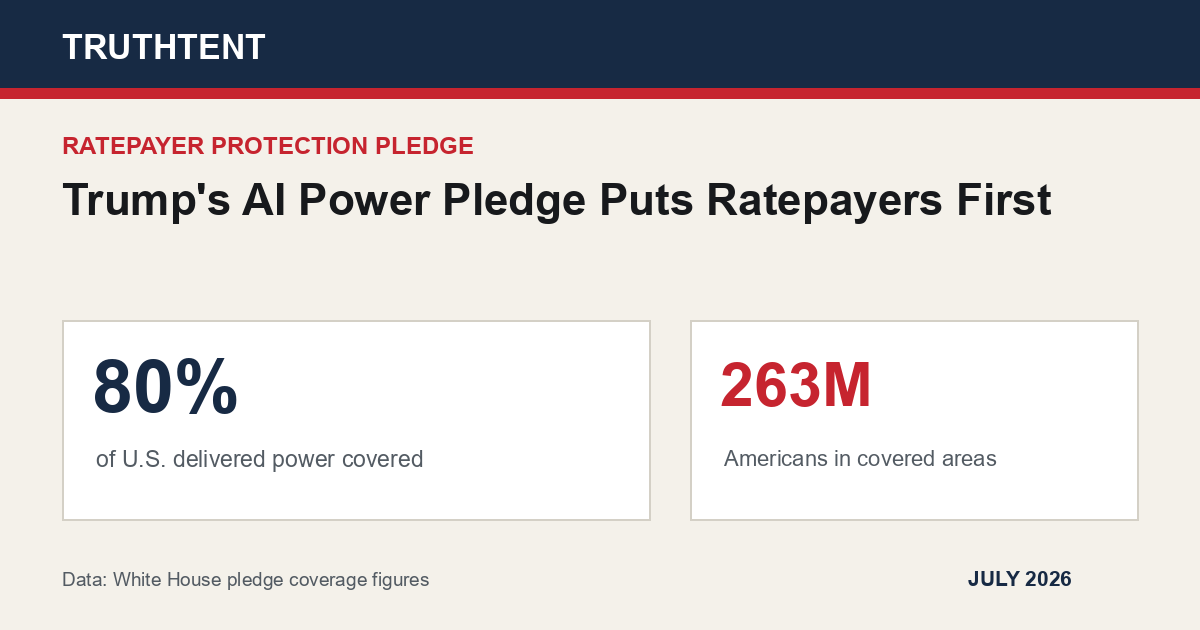
The White House says the coalition now covers about 80 percent of electricity delivered to American homes and businesses. It lists 23 governors, seven major technology buyers, more than 250 utilities and cooperatives, and dozens of data-center developers. Together, those areas include roughly 263 million people.
There are already concrete agreements
This isn’t only a Washington promise. Several utilities have negotiated special arrangements tied to large data-center loads.
In Georgia, regulators approved a plan that freezes Georgia Power base rates through at least 2028. In Mississippi, an Entergy agreement with Amazon is projected to produce about $2 billion in customer benefits while the project covers transmission and related costs.
In Texas, Crusoe says its expanded Abilene campus will use 900 megawatts of on-site natural-gas generation and battery storage for the next phase. That approach brings its own permitting and fuel questions, but it is a clear example of a developer bringing power instead of quietly handing the demand to existing customers.
Why the pledge fits an America First energy policy
America can lead in AI or watch the computing, investment, and strategic advantage move overseas. Refusing to build power is not a serious option.
Trump’s approach connects growth with responsibility. Build the data centers. Build the generation too. Pay the full cost. Hire locally. Make backup resources useful to the surrounding grid when possible.
That is stronger than a policy that celebrates every ribbon cutting and leaves state regulators to sort out the household bills later. It also fits the supply argument in TruthTent’s analysis of record U.S. oil production: abundant energy gives the country more room to grow, but the infrastructure and pricing rules still matter.
A pledge is not the same as enforcement
The commitments are public, but many of the actual rates are negotiated through utilities and state regulators. The White House does not set every local electric bill. Contracts, commission orders, cost-allocation rules, and future rate cases will decide whether families are truly protected.
Coverage figures also need context. Saying a participating utility serves a region does not mean every future project in that region automatically has a perfect contract. Each large load should face transparent terms and independent regulatory review.
The phrase “customer savings” deserves scrutiny too. Regulators should show the baseline, the contract period, what costs are included, and what happens if power demand changes. A promised benefit 15 years from now isn’t the same as a lower bill next month.
The four numbers every state should publish
Ratepayers need a short scorecard for each major data-center project: the peak megawatts requested, the cost of new generation, the cost of transmission and distribution upgrades, and the share assigned to the data center.
States should also disclose contract length, minimum payments, exit protections, and any tax incentives. None of that requires exposing trade secrets. It simply lets the public see whether “pay your own way” is a rule or a slogan.
Local reliability belongs on that scorecard as well. A project may pay every assigned dollar and still strain a region if generation arrives late or transmission work falls behind. Customers need both fair cost allocation and dependable service.
Trump has identified the right problem early. AI infrastructure can strengthen the economy, national security, and American technology leadership. It shouldn’t become a backdoor transfer from households to some of the world’s richest companies. The pledge sets a sound standard. Now regulators and signatories have to prove they are following it.
Documents reviewed: the White House Ratepayer Protection Pledge, its July coverage update, Georgia Power’s approved rate plan, Entergy’s Mississippi customer-benefit summary, and Crusoe’s Abilene project announcement. Last reviewed July 29, 2026.
