
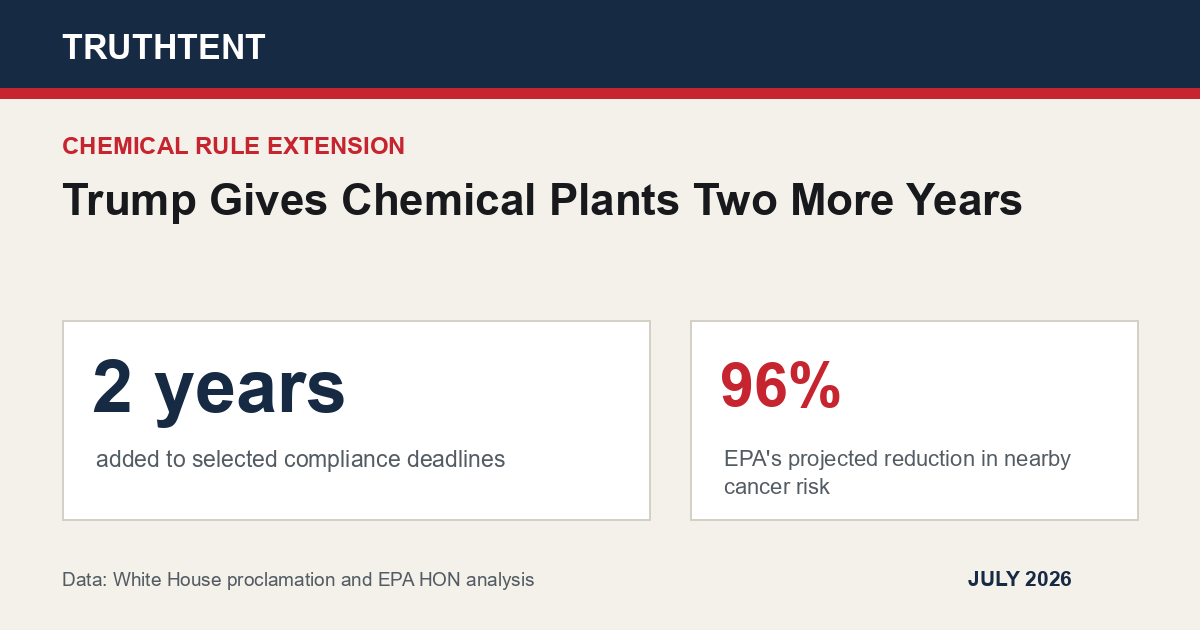
President Trump has given selected chemical plants two additional years to comply with parts of a major federal air-pollution rule. His argument is straightforward: forcing plants to install unavailable equipment on an unrealistic schedule could shut down domestic production that defense, health care, agriculture, and semiconductor makers need.
That case deserves to be heard. So does the reason the rule exists. The chemicals at issue include substances linked to cancer, and delaying controls can impose costs on families living near industrial sites.
What Trump’s EPA exemptions actually do
The July proclamation applies to stationary sources listed in an official annex. It extends relevant compliance deadlines under the 2024 Hazardous Organic National Emission Standards for Hazardous Air Pollutants rule, usually called the HON Rule, by two years.
During the extension, the selected plants do not operate without air rules. The presidential proclamation says they remain subject to the standards that applied before the 2024 changes.
Trump used section 112(i)(4) of the Clean Air Act. That provision permits a temporary presidential exemption when the required control technology is unavailable and the continued operation of the source is in the national-security interest.
The administration says both conditions are met. It argues that some monitoring and control systems are not commercially available at the scale or in the configurations the plants need. It also says interrupted chemical output would increase dependence on foreign suppliers for critical materials.
The manufacturing case is bigger than one industry
Chemical plants sit near the beginning of many supply chains. Their products become inputs for medical-device sterilization, chips, plastics, fuels, coatings, pharmaceuticals, fertilizers, and weapons systems. A shortage at one specialized plant can stop production far downstream.
The White House says the affected facilities make materials important to semiconductors, health care, advanced manufacturing, and national defense. That is a legitimate national-security concern, especially when China controls or influences important parts of several industrial supply chains.
Regulators also have a poor record of assuming that equipment can be bought, permitted, and installed on a uniform schedule everywhere. Plants differ in age, layout, local permits, and the processes they run. A deadline that is manageable for one site may require a long shutdown at another.
This is the strongest conservative case for the extension: rules should account for engineering reality, and Washington should not trade a domestic supply problem for a paper compliance victory.
The health cost cannot be waved away
The 2024 rule targeted hazardous pollutants including ethylene oxide, chloroprene, benzene, 1,3-butadiene, ethylene dichloride, and vinyl chloride. Several are associated with cancer or other serious health effects.
When EPA adopted the rule, it said the changes would reduce air-toxic cancer risk for people living near covered chemical plants by 96 percent. The agency’s technical overview also emphasized stronger fence-line monitoring, which is intended to identify harmful emissions escaping beyond a plant boundary.
Those benefits are projections, not a guarantee that every plant would produce the same improvement. Still, they are not disposable. A family living beside an industrial corridor has the same claim to government attention as a worker worried about a plant closing.
A credible America First policy should protect both. Keeping strategic production at home is not much of a victory if nearby communities absorb avoidable exposure without timely data or a plan to reduce it.
A two-year extension needs public milestones
The best way to defend the exemptions is to treat them as time bought for compliance, not a quiet promise that nothing will change. Each covered facility should identify the equipment or engineering barrier that justified its extension, the controls it will install, and the dates it expects to complete the work.
EPA should also preserve monitoring where technically possible and publish emissions data in a form local residents can understand. Transparency would help separate a genuine supply-chain problem from a company that simply prefers to delay spending.
The agency maintains a public page on section 112 exemptions, but the real test is facility-level detail. National security should not become a label broad enough to cover any industrial inconvenience.
The policy can work if the extension is used
Trump is right to question federal deadlines that threaten essential domestic production before workable technology is ready. The country has spent decades discovering how fragile an outsourced supply chain can be. It would be foolish to create another dependency through careless regulation.
But the administration should not pretend the pollution risk is imaginary. The two-year delay is defensible only if it produces a practical path to lower emissions while plants keep operating.
That is a tougher standard than either side’s slogan. It is also a better one: keep the factories, protect the workers, show the monitoring data, and use the extra time to solve the engineering problem.
Documents reviewed: the White House proclamation and fact sheet, EPA’s HON materials, and EPA’s exemption guidance. Last reviewed July 29, 2026.
