
President Trump’s new trade agreement with Jordan is easy to describe as another tariff deal. Read the text and it turns out to be much broader.
The agreement covers American farm goods and vehicles, but it also reaches digital taxes, forced-labor imports, customs systems, intellectual property, export controls, investment screening, and critical minerals. That makes it a useful example of what “reciprocal trade” now means inside the Trump administration.
What the Jordan trade deal changes
Jordan will continue duty-free treatment for almost all qualifying American goods under the existing U.S.-Jordan free-trade framework. The new agreement focuses heavily on barriers that can block a product even when the tariff rate is zero.
Under the published agreement, Jordan agrees not to use import licensing as a hidden restriction. It must accept qualifying U.S. or international standards without unnecessary duplicate testing and apply food-safety rules on a scientific basis.
The text also removes a special tax on new U.S.-made vehicles that meet the existing rules of origin and are shipped directly from the United States. For automakers, that is the sort of unglamorous detail that can decide whether market access exists in practice.
American agriculture gets specific protections
The agricultural provisions require sanitary and phytosanitary measures to be science- and risk-based. Jordan agrees not to use unsupported standards that discriminate against American products.
There are also protections for common cheese and meat names. That can sound small, but naming rules have become a recurring trade fight. If a country treats an ordinary product term as a protected geographical label, an American producer can lose shelf space without any tariff appearing on the invoice.
Trump’s trade team is right to focus on both the visible tax and the rule behind the border. Market access means little if paperwork, testing, labels, or quotas can be used to close the same door.
Digital trade is a major part of the agreement
Jordan agrees not to impose a digital-services tax that discriminates against U.S. companies. It also commits to cross-border data transfers for business, cooperation on cybersecurity, and protection against forced transfers of source code or proprietary technology.
The agreement bars customs duties on electronic transmissions and asks Jordan to support a permanent international moratorium on those duties. Those clauses matter to software, cloud services, media, finance, and any smaller American company selling a digital product abroad.
This is America First trade applied to an economy where the valuable export may never sit inside a shipping container.
Forced labor and national security move into trade policy
Jordan commits to prohibit imports made wholly or partly with forced labor within five years after the agreement takes effect. It also agrees to recognize U.S. determinations involving companies targeted under Section 307 of the Tariff Act.
On security, Jordan will cooperate with U.S. export controls, sanctions lists, and investment reviews. The text addresses tariff evasion, transshipment, sensitive technologies, critical minerals, energy resources, and purchases of nuclear equipment from countries that jeopardize essential U.S. interests.
Those provisions show how much the trade debate has changed. Cheap goods are no longer the only goal. Washington is asking where a product came from, whether forced labor touched it, who controls the supplier, and whether the same supply chain could be used against the country.
That approach connects directly to Trump’s new defense supply-chain order and to TruthTent’s earlier analysis of the falling China trade deficit.
The announced investments are meaningful, not guaranteed
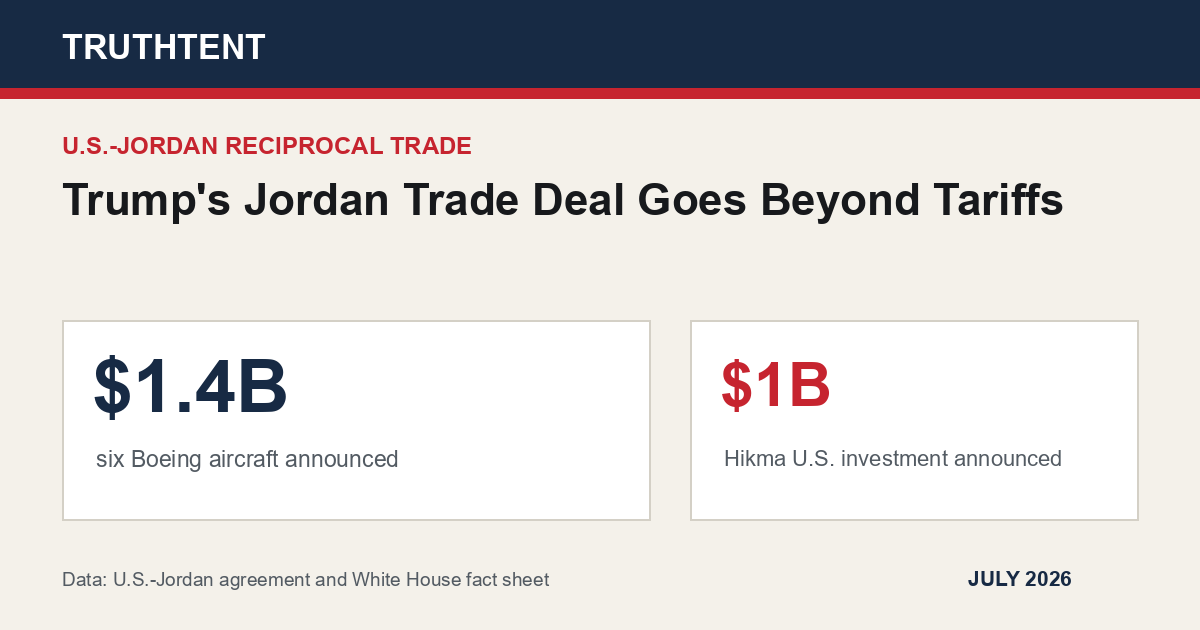
The White House says Royal Jordanian Airlines purchased six Boeing 787-9 aircraft valued at $1.4 billion and signed leases for additional aircraft valued at $500 million. Hikma Pharmaceuticals announced a $1 billion U.S. investment, while Jordanian companies agreed to buy more than $300 million in American raw materials each year.
Those are substantial commitments. They should still be tracked as purchases and investments move from announcement to delivery. Aircraft schedules can change, construction can slip, and an agreement’s economic value depends on businesses using it.
What happens before the deal takes effect
The terms do not become operative immediately. The agreement enters into force 60 days after both countries notify each other that their required internal procedures are complete.
Either side can terminate it with six months’ written notice. The United States also keeps the ability to impose additional tariffs under its own law to address unfair trade, import surges, or national-security concerns.
That flexibility gives Washington bargaining power, but it also means businesses will watch enforcement closely. A durable agreement needs predictable procedures, not surprise changes every time a dispute appears.
Trump’s Jordan deal is a serious piece of economic statecraft. It opens practical routes for American goods, protects digital trade, and ties a friendly regional partner more closely to U.S. security rules. The next test is execution: more American exports, completed investments, faster customs treatment, and visible enforcement when promises are missed.
Documents reviewed: the full U.S.-Jordan Agreement on Reciprocal Trade, its annex references, and the White House fact sheet. Last reviewed July 29, 2026.
